

AWC Helps Ohio Municipal RO Reduce Cleaning Frequency and Improve Performance
Download PDF →The Facility
A municipal potable water RO plant located in Northwest Ohio has a design capacity of 2 MGD. It receives water from brackish wells.
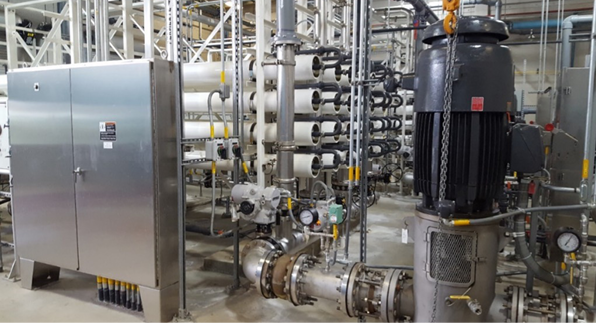
The raw water is initially treated by multimedia sand filters to remove particulates and precipitated iron, followed by 2 RO trains.
Potassium permanganate is injected upstream of the greensand filters as the oxidizing agent. Dechlorination is achieved with sodium bisulfite injection before feeding to the RO.
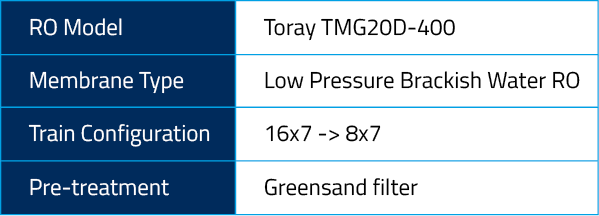
All membrane elements are Toray TMG-20D-400 with (16×7) -> (8×7) train configuration. The plant operates at 78% recovery.
The Problem
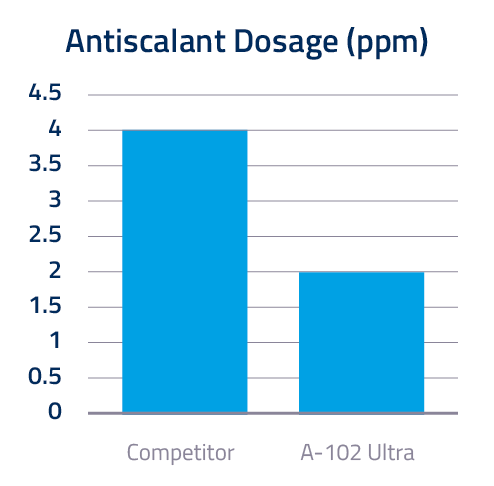
The Plant had long been using a competitors’ polyacrylic acid based antiscalant, dosed at 4 ppm.
The plant was cleaning the system due to dramatic increases in feed pressure every 2-4 months.
Each train takes 2 days to clean, so the drain on manpower was significant. The cost for labor and chemicals was considerable with the frequent cleanings.
The Solution
American Water Chemicals (AWC) performed a water analysis, and after running Proton® Software projection, determined that scaling could be controlled using 2 ppm of AWC A-102 Ultra.
AWC recommended AWC C-227 LF (low foaming) high pH cleaner and AWC C-205 low pH cleaner to remove the organics, biofilm, and carbonate scales. With the guidance of AWC on-site technical support, the operators cleaned the membranes with a 2% solution of each chemical.
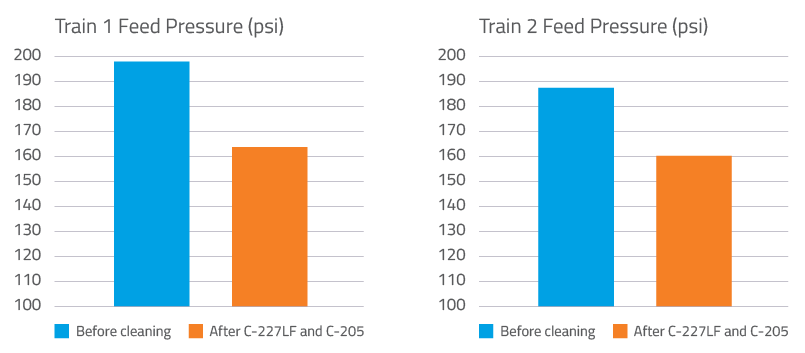
The result of the cleaning was a significant reduction in feedwater pressure. After cleaning, RO train #1 exhibited a feed pressure reduction of 35 psi, while RO train #2 presented a feed pressure reduction of 28 psi.
With AWC cleaning chemicals, the system was operated for 6 months before needing cleaning. Similar results were experienced during this second membrane cleaning.
The Results
The plant has now been operating for 1 year with AWC® A-102 Ultra antiscalant. The antiscalant dosage is half of the competitive product that was in use, reducing the antiscalant cost by 50%. While also using AWC cleaners and following the AWC cleaning protocol, the cleaning frequency has gone from every 2-4 months to every 6 months, reducing the operating cost and the burden on the WTP personnel.
Read the full case study
Download PDF